
Catalogue Entry

[the estate sale stamp at lower left has been painted over]
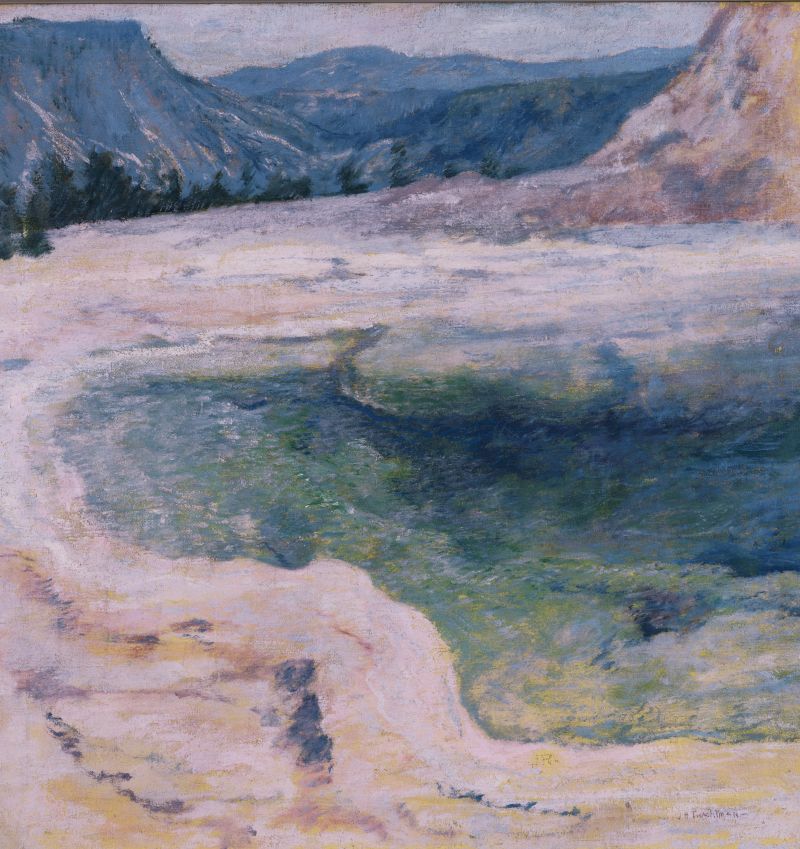
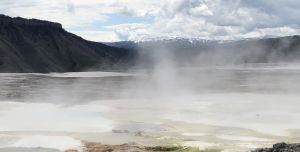
This painting has been known by the title of Emerald Pool since 1925. However, it is not a view of the Emerald Pool in the Black Sand Basin in the Upper Geyser Basin, near Old Faithful (depicted in Emerald Pool, OP.1311 and Edge of the Emerald Pool, OP.1313). Instead it is a pool in the Mammoth Hot Springs Terraces, near the northern entrance to the park. Mount Everts is at left; the foothills and silhouette of Bunsen Peak is at right. In between is the Washburn Range (fig. 1). The site is possibly Canary Springs. Tipping his canvas on an extreme forward angle, Twachtman combined the distant mountains, the cropped edge of the geyser, and the sunlit calcium-rich volcanic ground into a decoratively conceived abstract design oriented to the work's square format. Given the location, the painting was probably among Twachtman's first or last Yellowstone paintings.
This may have been the painting Twachtman exhibited as The Pool at the Art Club of Philadelphia in 1896, which was described in the Philadelphia Press as an image of “a snow-filled canyon or crevice in which the pool is conspicuous by its silence.” According to the newspaper, the scene featured “a group of huge rocks with a spray of water at their feet . . . aglow with that delicious light and play of color which Twachtman alone of our landscape painters beholds in nature.” While acknowledging that Twachtman’s scene was unusual, the writer stated that the painting was, nonetheless, “a picture clear, distinct, accurate and unmistakable, of the fashion in which sandstone cliffs in an early stage of erosion in an atmosphere considerably elevated above the surface of the sea, present themselves in the chill vision of quiet air which succeeds the first light snow of the season when it has come to stay.”
Not among the Yellowstone works owned by William A. Wadsworth, who funded Twachtman's Yellowstone trip, The Emerald Pool was included in the artist's estate sale and once bore a red estate sale stamp at its lower left, which was subsequently painted over, perhaps due to the presence of a signature (other works in the estate sale that were signed were not stamped). The painting was purchased from the sale by the architect Stanford White (1853–1906), who had come to know Twachtman in the 1870s, when both were members of the Tile Club.
- Museum website (https://www.phillipscollection.org/collection/emerald-pool)