John Henry Twachtman Catalogue Raisonné
An online catalogue by Lisa N. Peters, Ph.D., in collaboration with the Greenwich Historical Society
Print this page
« previous // return to Works // next »

Catalogue Entry

enlarge
Keywords
OP.1166
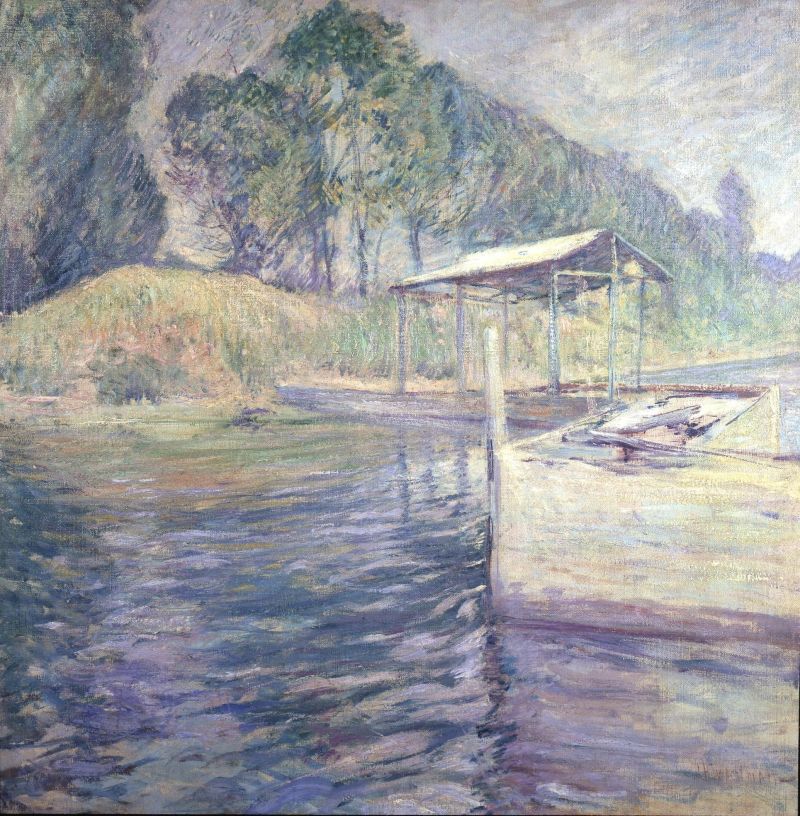
Reflections
Alternate title: Pier on Niagara River
ca. 1893
Oil on canvas
30 x 30 1/4 in. (76.2 x 76.8 cm)
Signed lower right: J. H. Twachtman–
Exhibitions
American Fine Arts Society, New York, Seventeenth Annual Exhibition, Society of American Artists, March 25–April 27, 1895, no. 233, as Pier on Niagara River.
Art Institute of Chicago, Exhibition of the Works of John H. Twachtman, January 8–27, 1901, no. 20, as Reflections.
Cincinnati Art Museum, Exhibition of Sixty Paintings by Mr. John H. Twachtman, Formerly Resident in Cincinnati, April 12–May 16, 1901, no. 55, as Reflections.
New York School of Applied Design for Women, Fifty Paintings by the Late John H. Twachtman, January 15–February 15, 1913, no. 37, as Reflections, lent by Alexander Morten, Esq.
Albright Art Gallery, Buffalo, New York, Paintings and Pastels by the Late John H. Twachtman, March 11–April 2, 1913, no. 28, as Reflections, lent by Alexander Morten, Esq.
Knoedler Galleries, New York, Ninth Annual Summer Exhibition of Paintings by American Artists, Summer 1916, no. 24, as Reflections.
Cincinnati Art Museum, Twenty-Fourth Annual Exhibition of American Art, May 26–July 31, 1917, no. 69, as Reflections, lent by M. Knoedler & Co.
Brooklyn Museum, New York, Leaders of American Impressionism: Mary Cassatt, Childe Hassam, John H. Twachtman, and J. Alden Weir, October 17–November 28, 1937, no. 64, as Reflections, lent by Horatio S. Rubens, New York.
Babcock Galleries, New York, Paintings, Water Colors, Pastels by John H. Twachtman, February 9–28, 1942, no. 6, as Reflections.
Brooklyn Museum, New York, Revolution and Tradition: An Exhibition of the Chief Movements in American Painting from 1900 to the Present, November 15, 1951–January 6, 1952, no. 80, as Reflections.
Knoedler Galleries, New York, Brooklyn Museum Collection, April 8–30, 1954, no. 39, as Reflections.
Spanierman Gallery, New York, Twachtman in Gloucester: His Last Years, 1900–1902, May 12–June 13, 1987. (Exhibition catalogue: Boyle 1987); (Exhibition catalogue: Gerdts 1987); (Exhibition catalogue: Hale 1987); (Exhibition catalogue: Peters 1987), no. 3, as Reflections.
Tokyo Metropolitan Art Museum, New York: A Magnet for Artists, April 15–June 12, 1994, no. 43, p. 82 ill. in color, as Reflections.
Literature
"The Society of American Artists." Art Amateur 32 (May 1895), p. 158, as Pier on Niagara River.
Critic 1895 probably
"The Fine Arts: Exhibition of the Society of American Artists." Critic new series 23 (March 30, 1895), p. 150, as Pier on Niagara River.
"Society of American Artists (Second Notice)." New York Evening Post, April 1, 1895, p. 7, as Pier on Niagara River.
"Society of American Artists. The Seventeenth Annual Exhibition." Sun (New York), March 24, 1895, p. 13, "a 'River in Summer".
E.A.F. "Art and Artists." Chicago Journal, January 5, 1901, p. 3, as Reflections.
Valuable Ancient and Modern Paintings. Auction catalogue. May 9–11, 1916. New York: American Art Association, 1916, lot 122, as Reflections.
Hale, John Douglass. "Life and Creative Development of John H. Twachtman." 2 vols. Ph.D. dissertation, Ohio State University, 1957. Ann Arbor, Mich.: University Microfilms, 1958, vol. 1, pp. 215, 217 ill. in b/w (fig. 30); vol. 2, pp. 565-66 (catalogue A, no. 493), as Reflections. (Hale concordance).
Brooklyn Museum. The Brooklyn Museum: American Paintings. New York: Brooklyn Museum, 1979, p. 115 ill. in b/w, as Reflections.
Peters, Lisa N. "Catalogue." In Twachtman in Gloucester: His Last Years, 1900–1902, by John Douglass Hale, Richard J. Boyle, and William H. Gerdts. New York: Universe and Ira Spanierman Gallery. Exhibition catalogue (1987 Spanierman), pp. 47, 54–55 ill. in color, as Reflections.
Peters, Lisa N. "John Twachtman (1853–1902) and the American Scene in the Late Nineteenth Century: The Frontier within the Terrain of the Familiar." 2 vols. Ph.D. dissertation, City University of New York, 1995. Ann Arbor, Mich.: University Microfilms International, 1996, vol. 1, p. 363; vol. 2, p. 902 ill. in b/w (fig. 388), as Reflections.
Peters, Lisa N. "John Henry Twachtman: River Scene with Pier, ca. 1893." In Twelve American Masterpieces. New York: Spanierman Gallery, 1998, p. 57 ill. in color, as Reflections.
Carbone, Teresa. American Paintings in the Brooklyn Museum: Artists Born by 1876. Brooklyn: Brooklyn Museum, 2006, pp. 1025 ill. in b/w, 1026, as Reflections.
Commentary

Reflections is likely to have been shown at the Society of American Artists in March 1895 as A Pier on Niagara River. The work on view was described in the Art Amateur as “firmly painted,” conveying “a distinct impression of the place—the embankment with its long line of trees, the crooked pier head, with its pent house and the force of water gliding past it.” The Critic mentioned the painting as “a successful study in many ways, but hardly in giving motion to the water, which, we imagine, was his leading intention.”

Given this identification, the painting could have been that on which Theodore Robinson commented in his diary on July 1, 1894: “Called on . . . Twachtman . . . and he showed us some canvases done at Ni[a]gara, very good—one square one—30 x 30 is particularly good. One, on the river, is pretty, but looks to me a little too much like a Monet.”[1]

Reflections may have been Twachtman’s title for the painting. A work with the title Reflections was included in his 1901 exhibitions in Chicago and Cincinnati. A critic for the Chicago Journal wrote that two of the works on view, Reflecting and Reflections, “both done on the water” were “as entrancing in color as any Venice scene ever painted—if seen at the distance of across the room. There is exquisite art in the most of Mr. Twachtman’s paintings, whether most people or only the few admire it or not. On no other canvases are seen so much light and color.”

Perhaps purchased by a collector during Twachtman’s lifetime, the painting belonged to the New York art dealer Alexander Morten by 1913. It was included in the sale of the Morten collection in 1916, from which it was acquired by Knoedler for $2,000. Knoedler sold it to Milch in May of 1919 for $2,625.[2] Subsequently it was in the collection of lawyer and art collector Horatio Seymour Rubens (1869–1941). The painting was one of a group of sixty-seven paintings from the Rubens collection that Knoedler handled in 1944, and the gallery sold the work that year to the Brooklyn Museum.[3]


[1]Theodore Robinson diaries, July 1, 1894, Frick Art Reference Library, New York.

[2] Knoedler Book 6, Stock No. 13860, p. 122, row. 31. Dealer Stock Books, M. Knoedler & Co., Records, Getty Archives.

[3] Knoedler Book 9, Stock No. A2866, p. 73, row. 19. Dealer Stock Books, M. Knoedler & Co., Records, Getty Archives.

Selected Literature

From Carbone 2006

Reflections is somewhat unusual in the expansive quality of the composition, a feature strongly influenced by the site itself as well as by the French Impressionist works of Claude Monet, with which Twachtman was especially familiar from 1893 . . . . The receding river view, organized along a strong diagonal that is further accentuated by the line of tall trees lining the bank, is countered by the sharply foreshortened form of the angular pier. The compositional similarity to Monet is attributable in part to the interest of both men in the aesthetic of Japanese prints. . . . Here the Japanese influence is visible in the sweeping compositional lines and square format of the canvas, a device often employed by Monet and used from an early date by Twachtman, additionally encourages the reading of the canvas a two-dimensional design. Twachtman’s brushwork in this canvas is particularly reminiscent of Monet’s. As the title Reflections suggests, Twachtman was especially interested in the description of the watery foreground, where he suggested the reflections through a juxtaposition of broadly applied purple, blue, green, and yellow tones. Throughout the canvas, the lively brushwork conforms to the shapes of the pictorial elements. The overall result is a sense of visual vibration that is a departure from Twachtman’s customarily muted, evocative effects.