
Catalogue Entry
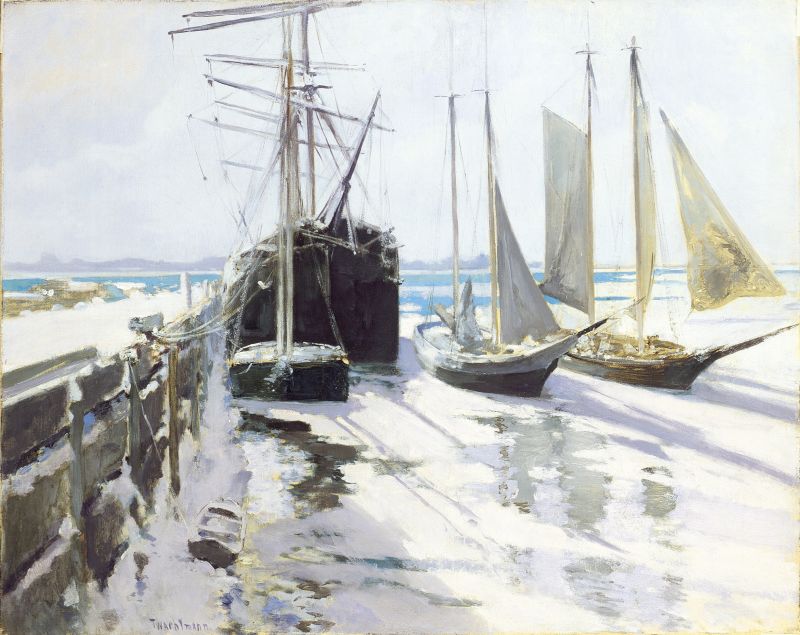

This painting is related in subject and style to Snowbound (OP.806) and it also features ships locked in by ice in a harbor. At the left, the horizontal timbers of a finger pier recede, a low sailing barge and a large black ship seen from the bow docked alongside it. Nearby are two foreshortened schooners, their sails hoisted in the calm air. In the foreground, an abandoned rowboat establishes a sense of scale, resembling a floating keg in a Dutch seascape.[1]
The painting is possibly the work titled Snowbound in the Second Annual Exhibition and Sale of Paintings by American Artists, Selected and Owned by Mr. Newman E. Montross of 1380 Broadway, New York (see Exhibitions). A reviewer for the New York Sun commented: “Twachtman has never been more wholly picturesque than in ‘Snowbound,’ which has a couple of ice imprisoned vessels for a motive.” The New York Tribune reviewer wrote: "Mr. W. M. Chase’s bright 'study on the East River,' is one of the pleasant things of the collection and Mr. Twachtman’s large 'Snowbound' is certainly one of the serious attempts. The blue-snow shadows so popular for the last few years, appear as an incident in a strongly-drawn picture of the black bulls and naked spars of ships ice-bound at the wharf."
If the painting was sold from the Montross sale, its purchaser is unknown. The painting's earliest recorded owner is the artist William Sergeant Kendall (1869–1938), in whose family it remained until 1985. When this painting was in the collection of the Hartford Steam Boiler Company, from 1985 to 2001, it acquired the title of Connecticut Shore, Winter. However, its location has yet to be pinpointed. It is clear from this painting and the aforementioned Snowbound that Twachtman was drawn to "Snowbound" as a title, using it for an image of ships and then reusing it in the 1890s for views of his Greenwich home locked in by heavy snows.
[1] For consultation on this scene and its vessels, I would like to thank Craig Bruns, chief curator, Independence Seaport Museum, Philadelphia. In Bruns's opinion, the scene is inconsistent with the waterfront on the Delaware River in Philadelphia, for which there is evidence that Twachtman rendered in 1888.