
Catalogue Entry
- Periods
: - Locales
: - Subject matter
:
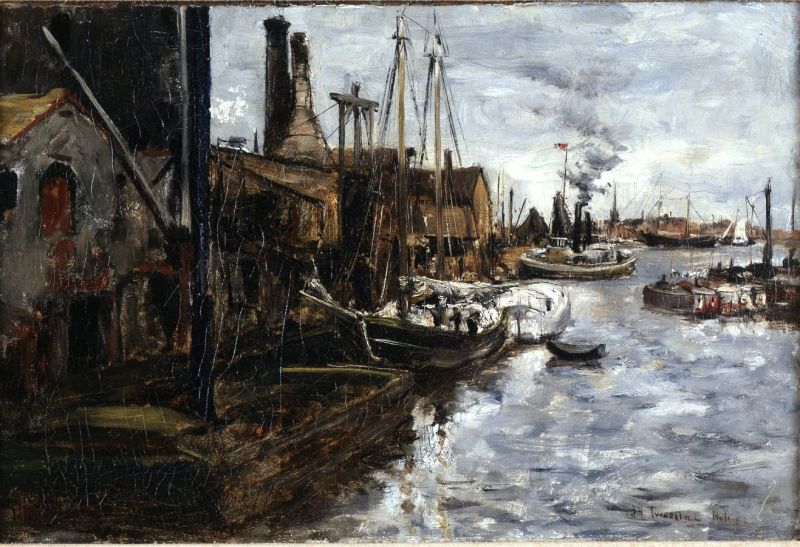
In this scene, Twachtman captured the bustle of New York's industrialized waterfront in the late 1870s. His view in the work, at the level of the pier, draws the viewer's eye on the rapidly receding diagonal, cluttered with warehouses, cranes, smokestacks, and barges, into the distance. The artist placed an American flag at the vanishing point, around which smoke swirls from a tugboat, as if to label the scene and its energy as distinctively American. At the right edge of the composition, the form extending into the harbor is perhaps one of New York's floating garbage dumps, some of which were large enough to be divided into rooms where indigents lived and from which they sold retrieved items.
Finding aesthetic value in such a modern life subject, this painting anticipates the works created in the early twentieth century by New York Realists, such as William Glackens and George Luks.
Several titles have been assigned to this work. It was listed as End of the Pier in Twachtman’s 1903 estate sale. There it was purchased for $50 by Julian Alden Weir, who acquired it along with six other works. When Weir sent the painting four years later to Twachtman's memorial show at the Lotos Club, New York, it was identified in the catalogue as New York Harbor. The painting was shown as Waterfront in New York in 1958, when Weir’s daughter Caroline (Mrs. G. Page Ely) lent it to an exhibition at the Lyman Allyn Museum in New London, Connecticut.