
Catalogue Entry
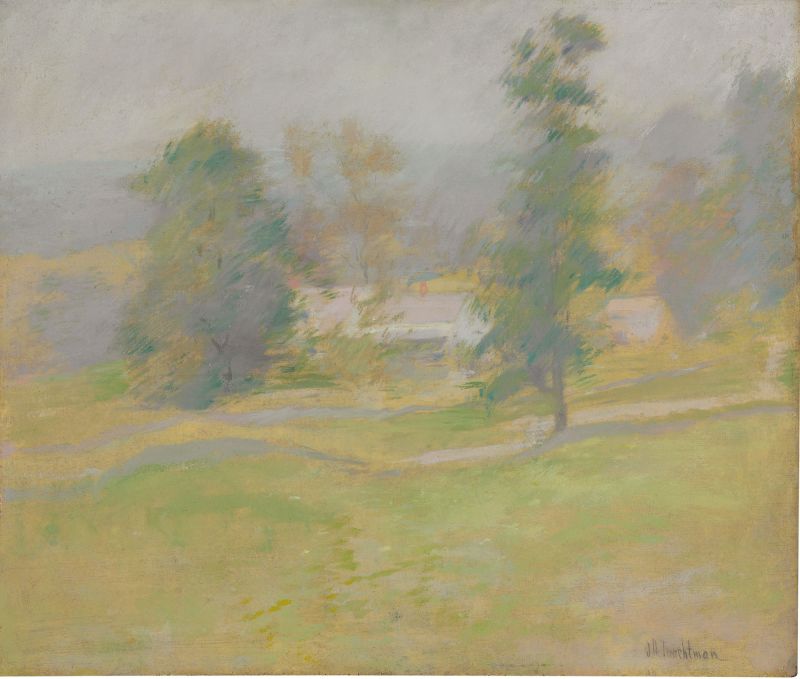

Here Twachtman depicted a view looking northwest from the east side of Round Hill Road, toward the front facade of his Greenwich home, with the family’s barn visible in the right distance. The painting was created between 1890 and 1892, given the presence of the central chimney on the older (eastern) section of the dwelling. Twachtman’s addition to the home is at the left, featuring a higher and narrower profile.
The painting was perhaps intended by Twachtman as a counterpart to another work titled Spring Landscape (OP.904). Both are in oil on panel and exactly the same size. The tree that is prominent at the right here (probably a maple) is on the left in Spring Landscape (OP.904), in which the road extends behind the house, whereas here it is on a diagonal in front of the house. Taking the reverse perspective enabled Twachtman to consider his different responses to his home that were the result of where he stood and the feelings that particular vantage points evoked. Here the home appears more distant, a place to see in passing, by contrast with his view toward its north facade, where it draws the viewer in and seems more inviting.
In both works, Twachtman used a method in oil that relates to his use of pastels in the late 1880s, consisting of pastel colors layered with a loose brush over a toned ground.
This painting was owned by James Parmelee (1855–1931), a Cleveland businessman who was a benefactor of the Smithsonian Institution and one of the founders of Case Western University. It was bequeathed to the Corcoran Gallery of Art in 1941 and deaccessioned in 2010.