
Catalogue Entry
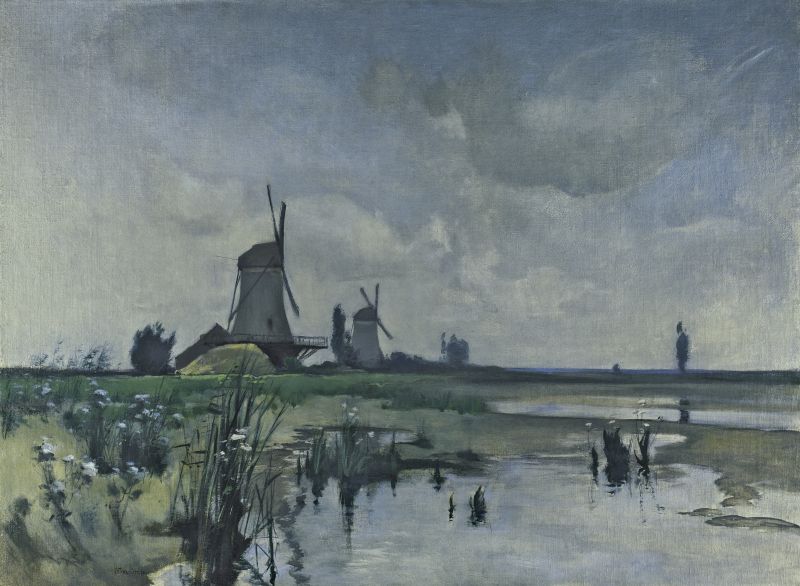

Next to Arques-la-Bataille (OP.731), Windmills is the most significant work of Twachtman's French period, representing the renewed interest he took in the Dutch countryside in the summer of 1885. The painting's significance was clear when it was exhibited at J. Eastman Chase's Gallery, Boston, in 1886. There, listed in the catalogue as Hollandsch Diep, it was the key work in the show. This title identifies the painting's site as the estuary to the south of Dordrecht formed by the Rhine and Meuse rivers, a body of water resulting from extensive flooding in the thirteenth century.
The largest of Twachtman's Dutch landscapes, this painting was probably based on plein-air studies, including pastels, Landscape with Windmill (P.705) and The Windmill (P.706), and the etching, Mill in Holland (E.702). It demonstrates his return to greater naturalism and more paint volume than in Arques-la-Bataille. Nonetheless, it is a work in which he focused on distinctions and subtleties rather than on topography. The author and artist Susan Hale (1833–1910) made this point in describing her response, in third person, to it and other Dutch scenes on view at Chase's:
by and by, in the quiet of the place which she had all to herself, she began to find a great charm in the pictures, great depth in the perspective, light in the skies, and good drawing in the foregrounds; she discovered that if the reeds and grasses were "scrabbled," they were scrabbled with a master hand, which had in no instance failed to convey their meaning, and seeing these things she became reconciled to the frequency of windmills, reflecting that, though there may be a surplus in this collection, there are absolutely no windmills at the Art Club exhibition, although, if there were, they might possibly be less well drawn than Mr. Twachtman's.[1]
A critic for the Boston Evening Transcript remarked on visiting Chase's that “at first the painting appears as a mere impression, in which the artist has neglected ‘form,’ but that gradually the scene takes hold of the viewer.”
Twachtman may have felt the title, Hollandsch Diep, was too obscure, and he showed the painting as Windmills at the Society of American Artists annual in 1888. There, it won the Webb Prize, given to the best landscape in the show by an American artist under the age of forty. It was purchased by Smith College from Twachtman in or before 1902 and was still in Smith’s collection when it was included in the special display of Twachtman's work at the Panama-Pacific International Exposition in 1915. In 1918, the college traded the painting for a work by George DeForest Brush (also later deaccessioned) and $1,200 to Knoedler Gallery. The gallery sold the painting a year later for $3,000 to Mrs. Charles H. Keep, the wife of the president of the Columbia-Knickerbocker Trust Company, based in New York.[2]
[1] Hale 1886.
[2] Knoedler book 6, stock no. 14341, page 163, row 13, Getty Archives, Knoedler Gallery, Dealer Stock Books. http://piprod.getty.edu/starweb/stockbooks/servlet.starweb.
From Boston Evening Transcript 1886
The chief picture of the exhibition is the “Hollandsch Diep,” a large canvas hanging in the place of the "Chatean Garden" of last year. In the centre of the picture rise the dark shapes of several windmills, vanishing in the distance; the foreground is low, sandy marsh, with parts of gray water and harsh, rank rushes; a curve of slow river winds off on the right, and far away lies the dull blue line of the sea. The sky is full of vast, vaporous masses of clouds, and the air is wet and still, with faint light diffused through it. One finds fault with the picture at first, because its handling is so curiously vague and coarse, and because the quality of form is entirely absent, but of a sudden critical capacity fails and the consciousness comes that a great mistake has been made, and that Mr. Twachtman cared nothing for these things. For very subtly the picture itself begins to exert is influence. This level waste, with its infinite distance, these silent and impressive windmills, the dull, gray water, and the great, vacant, luminous sky combine to form a picture that has a distinct and decided influence; it is certainly impressive. Mr. Twachtman has discriminated delicately, and has produced a picture that, while lacking the truth of form of Nature, yet has that which is always sacrificed—truth of impression. Technically the sky would pardon all that is bad in the picture—it is masterly; the effect of blue sky seen through drifting fog is wonderfully good, and the great clouds themselves are in quality, form and luminosity truly wonderful.
From Art Amateur 1888–I
This . . . was one of the largest landscapes in the collection; two large mills with their towers and vanes seen almost flat against the gray sky, stand on the borders of a quiet canal, whose waters, and those of the pool in the foreground, reflect the sky; two or three slight clumps of trees also serve to break the horizon line, and in the left foreground rise the sandy banks and tall reeds of the edge of the pool. The atmospheric tones of the picture give it its greatest charm—a sense of quiet, as though the wind never blew too roughly in these great wings.
From Nation 1888
“Windmills,” No. 118, by John H. Twachtman, is a picture presumably of a Dutch motive, in which there are excellent qualities of line in the drawing of the ground and the sky is luminous and delicate in color, although the ensemble gives rather the effect of a decoration in flat tones than that of the enveloping quality of atmosphere.
From New York Sun 1888–I
Yet it seems as though the public found in this piece of work—really a masterly work for a man so young as Mr. Benson—merely a proof of eccentricity, a willful exaggeration of natural facts. The same is very likely true of Mr. Twachtman's sympathetic, varied, and charming landscapes, especially of the large one called 'Windmills,' in which nature is shown in a mood just the reverse of that which Mr. Benson selected, in one of these gray, soft, almost lifeless moods when local colors, although much more emphatic than the average old-school painter would have us believe, are yet blended and fused together in a prevailing silvery tone. The way in which Mr. Twachtman gives this tone while preserving local color is of extreme interest.
At the exhibition of the Society of American Artists the prize of $300.00 instituted last year by Dr. W. Seward Webb, for the best landscape in the exhibition by an American artist under forty years of age, has been awarded to Mr. John H. Twachtman for his large painting of “Windmills,” No. 118 in the catalogue. At the display of the Society last year this prize was carried off by Mr. J. Francis Murphy, with his painting “Brook and Fields.” By the terms of the donation, an artist having once received the prize, will not be considered a second time. Mr. Murphy's picture was a glowing and decorative color study, a sympathetic transcript of one of Nature's richest moods; Mr. Twachtman's on the contrary, is a gray landscape that is somewhat more impressionist and realistic than Mr. Murphy's, but yet not entirely unsentimental. Two tall windmills relieved against the sky, stand on the bank of a placid canal that flattens out into a still pool in the foreground, the tall reeds and grasses, and the sandy banks are well indicated, but not carried very far, and on the farther shore, in the middle distance, a single poplar repeats the perpendiculars of the windmills. If the picture is not definitely the best landscape in the exhibition, it would be difficult to select another, without a human figure, that was better, taking it altogether.
From Clark 1924
“The Windmills” . . . is a most felicitous arrangement, wherein we find a very exact adjustment of the relative positions of masses and the division of areas. Gray in tone, the effect is produced by light and dark, rather than color. We remark again the picture plane beginning in the immediate foreground and the skillful treatment of rushes and flowers. Executed with technical mastery and quite perfect in presentation, the composition is, however, rather over obvious and insufficient in volume to fill such a large canvas. This may be due to the fact that the large pictures were painted after smaller studies and in losing something of their intimacy do not gain in grandeur.
From Hale 1957
A typical oil from this phase of the painter's development, Windmills . . . illustrates almost all the significant points of the French period. Nowhere in Windmills are there marked traces of brushwork to distract the viewer from the subject matter and pictorial mood. The realism of the scene is enhanced by the introduction of foreground vegetation handled with considerably more care than that in The River [OP.720], for example, although without actual literalness of detail. The horizon is more than typically low and, to add even greater authenticity to the view, its organization is made to appear as though it were no more than a fortunate choice of painting.
Actually a very little study will reveal that the scheme is plotted, not accidental. The viewer's eye is led unerringly into the work by the Baroque device of the immediate foreground object, here a group of grasses and flowering plants in the left center. From there it is pulled deeper and to the right in a flattened reverse 'S,' drawn by more of the same plant groups and the horizontal lines of the mud flats. A tree on the right horizon points the way upward but clouds tend to keep the vision from escaping and bring it around to the left until the form of the largest mill takes over to deposit it safely back at the starting point. Any tendency for the eye to move leftward from the initial entrance point is controlled by the sweep, upward and to the right, of the left bank and its flora, aided by a large spot of a tree in the left background [pp. 207–8].
From Peters 2006
Perhaps the sense that in his Normandy scene [Arques-la-Bataille, OP.731] he had retreated too far from a recognizable locale inspired Twachtman to return to a greater degree of detail and specificity in Windmills. Instead of treating his forms as abstract shapes and suspending the viewer within the space, as in Arques-la-Bataille, here the spatial recession is measured and convincing; we are drawn slowly from the foreground, where the reflective surface of the low water has gathered, across the flat terrain—shifting in tone from the sandy banks to the grassy distance—to the receding forms of the two windmills and toward a tree or mill on the horizon. This rhythmic movement draws us slowly in a circular direction through the arrangement, creating a feeling akin to the repetition of a meditative mantra. Thus, at the end of his French period, Twachtman merged the draftsmanship skills he had learned in Paris with a new kind of vision of art, as a vehicle for emotive expression, an approach that would be associated with American Tonalist art in the following decade.